Showing posts with label Classic Movies. Show all posts

Friday, July 22, 2011

#6 DZP: Citizen Kane & East of Eden


"Orson Welles reinvented movies at the age of 26 with this audacious biography of newspaper baron Charles Foster Kane, which, in essence, was a thinly veiled portrait of publishing magnate William Randolph Hearst. Welles's complex and technically stunning film chronicles Kane's rise from poverty to become one of America's most influential men -- and it's considered one of the best movies ever made." Netflix
I tried to pay attention to the best I could (dealing with the baby and all), but it shows me a new light to the newspaper... besides of course the Clark from Superman. I can see how this movie really gave movie producers a run for their money. This movie had like 10 Academy Award nominations! Welles played a terrific role and nailed every emotion the rollercoaster took you on.


"Set in California's Salinas Valley, Elia Kazan's adaptation of John Steinbeck's novel centers on Cal Trask (James Dean), the black sheep son of a stern farmer(Raymond Massey). Tired of being compared to his perfect brother, troublemaker Cal tries in vain to please his father. The two finally face off when Cal confronts his dad with the truth about his allegedly dead mother. Julie Harris, Jo Van Fleet and Burl Ives co-star." Netflix
 Train-traveling Cal is a confused young man who doesn't know who he is and starts trouble trying to see his mother, and wants to know why his mother ran out on them. This is the first time I've seen the handsome Dean in one of his movies... yes, I have not seen Rebel.

This completes my #6 on my DZP! 10 Classic movies done!
•The Best Years of Our Lives, 1946
•A Streetcar Named Desire, 1951
•The Heiress, 1949
•Rebecca, 1940
•Lawrence of Arabia, 1962
•A Tale of Two Cities, 1935
•To Kill a Mockingbird, 1962
•Little Women, 1933
•East of Eden, 1955
•Citizen Kane, 1941

Friday, February 4, 2011

#6 DZP: To Kill a Mockingbird


Scout and her brother Jem, live in the fictional town of Maycomb, Alabama, during the 1930s. The story covers three years, during which Scout and Jem undergo changes in their lives. They begin as innocent children, who spend their days happily playing games with each other and spying on the town bogeyman, Boo Radley. Through their father's work as a lawyer, they begin to learn of the racism and evil prevalent in their town, and mature painfully as they are exposed to it. - Wikipedia

Finch: "It's a sin to kill a mockingbird."


Now I loved reading this book when I was in high school. I even named my kitten Scout because she was a tomboy! But I've never seen the movie till now, and Gregory Peck was very nice to see in this!

I love all the characters in this book/film. Atticus Finch is a great father for raising 2 motherless children, and can really shoot a gun! Jem is brave and rugged; he always wants to be the leader and treats Scout like a little brother. Hence why Scout acts like a tomboy, and is shy when she has to wear a dress for school. Scout is my favorite out of the children: she's smart for her age and wants to learn about everything, and she gets into fights!

#6 DZP: The Birds


A wealthy San Francisco socialite (Melanie Daniels) meets and pursues a potential boyfriend (Mitch Brenner) from a San Francisco animal shop to a small Northern California town called Bodega Bay that slowly takes a turn for the bizarre when birds of all kinds suddenly begin to attack people there in increasing numbers and with increasing viciousness.


Annette brought this movie over one night because it's one of her favorites, and I've never seen it... nor really any Alfred Hitchcock film. Straight from the get-go, I knew the Melanie Daniels character was going to be an odd and strange lady. She meets a good looking man and immediately calls up her contacts to find out his name and address. Then she finds out from his neighbor where he spends his weekends, Bodega Bay... crazy stalker!! Then it gets better: she drives to Bodega Bay, finds out the house, his younger sister's name, and then rows a boat across the bay to the house!! He is cute, but jebus, she went through a LOT for the pursuit!

Now thanks to Annette, everytime that I see a flock of birds, or bird sitting across the wire, or bunching up here and there... I'm going to think about this movie and resort to the people who's eyes were plucked out from and murdered by the birds. Oh and seagulls no longer say "Mine?" so innocently!

Sunday, August 15, 2010

#6 DZP: A Tale of Two Cities 1935

A Tale of Two Cities is a 1935 film based upon Charles Dickens' 1859 historical novel, A Tale of Two Cities. The film stars Ronald Colman as Sydney Carton, Donald Woods and Elizabeth Allan. The supporting players include Basil Rathbone, Blanche Yurka, and Edna Mae Oliver. It was directed by Jack Conway from a screenplay by W.P. Lipscomb and S.N. Behrman. The film was nominated for the Academy Award for Best Picture and Best Film Editing. The story is set in the French Revolution and deals with two men who are alike, not only in appearance, but in their love for the same woman.

On the eve of the French Revolution, Lucie Manette (Elizabeth Allan) is informed that her father (Henry B. Walthall) is not dead, but has been a prisoner in the Bastille for many long years before finally being released. She travels to Paris to take her father to her home in England. Dr. Manette has been taken care of by a friend, Ernest Defarge (Mitchell Lewis), and his wife (Blanche Yurka). The old man's mind has given way during his long ordeal, but Lucie's tender care begins to restore his sanity.

On the trip across the English Channel, Lucie meets Charles Darnay (Donald Woods), a French aristocrat who, unlike his unfeeling uncle, the Marquis de St. Evremonde (Basil Rathbone), is sympathetic to the plight of the downtrodden French masses. Darnay is framed for treason, but is saved by the cleverness of the dissolute Sydney Carton (Ronald Colman). Carton goes drinking with Barsad (Walter Catlett), the main prosecution witness, and tricks him into admitting that he lied. When Barsad is called to testify, he is horrified to discover that Carton is one of the defense attorneys and grudgingly allows that he might have been mistaken. Darnay is released.

Carton is thanked by Lucie, who has attended the trial of her new friend. He quickly falls in love with her, but realizes it is hopeless. Lucie eventually marries Darnay, and they have a daughter.

By this time, the Reign of Terror has engulfed France. The long-suffering commoners vent their fury on the aristocrats, condemning scores daily to Madame Guillotine. Darnay is tricked into returning to Paris and arrested. Dr. Manette pleads for mercy for his son-in-law, but Madame Defarge, seeking revenge against all the Evremondes, regardless of guilt or innocence, convinces the tribunal to sentence him to death.

Carton comes up with a desperate rescue plan. He first persuades Lucie and her friends to leave Paris by promising to save Darnay. Then he blackmails an old acquaintance, Barsad, now an influential man in the French government, to enable Carton to visit Darnay in jail. There, Carton drugs the prisoner unconscious, switches places with him, and has Darnay carried out to be reunited with his family.

Madame Defarge, her thirst for vengeance still unsatisfied, goes to have Lucie and her daughter arrested, only to find that they have fled with Dr. Manette. As she goes to raise the alarm, she is confronted by Miss Pross (Edna May Oliver), Lucie's devoted servant. In the ensuing struggle, Madame Defarge is killed.

Meanwhile, only a condemned seamstress (Isabel Jewell) notices Carton's substitution, but keeps quiet. She draws comfort in his heroism as they ride in the same cart to the execution place.


Well if that wasn't depressing. I understand those might have been the times, but all the thirst for blood from the Reign of Terror of France was just so sad. They were slaves, but to kill innocent people or people that had spoke to a Aristocrat once in their life, would have to pay with death. Makes me wonder if politics will lead us to that same suffering one day...

It was very brave of Carton to take the place of Darnay, and to keep the poor seamstress company will they come down to the last minute of their lives. I wasn't sure about him, and I couldn't keep up with the names at first, but slowly when he fell in love with Lucie, you saw more of his character and started to feel the pain and suffering he was going through; a wonderful job by Ronald Colman indeed.

I did like the Christmas parts and of course seeing all the ladies fashion back then. And the way movies were filmed back then was interesting too. I never read Dickson's book, but this movie had enough emotion packed into (the less than 3 hour movie) it.

Tuesday, July 27, 2010

#6 DZP: Lawrence of Arabia

An inordinately complex man who has been labeled everything from hero, to charlatan, to sadist, Thomas Edward Lawrence blazed his way to glory in the Arabian desert, then sought anonymity as a common soldier under an assumed name. The story opens with the death of Lawrence in a motorcycle accident in London at the age of 47, then flashbacks to recount his adventures: as a young intelligence officer in Cairo in 1916, he is given leave to investigate the progress of the Arab revolt against the Turks in World War I. In the desert, he organizes a guerrilla army and--for two years--leads the Arabs in harassing the Turks with desert raids, train-wrecking and camel attacks. Eventually, he leads his army northward and helps a British General destroy the power of the Ottoman Empire. Written by alfiehitchie


Based on the memoirs of one of the most remarkable men of the twentieth century, Lawrence of Arabia tells the tale of TE Lawrence (Peter O'Toole), an obscure Oxford scholar who transformed himself into a fierce desert warrior and charismatic leader. He took on the might of the Ottoman empire with a rag-tag army of Arab tribesmen, and beat them!


On the way, Lawrence negotiates the treacherous intrigues of both Arab diplomacy and British military politics to achieve his end - the liberation of Arabia from the Turks. Blowing up trains or rustling up gold and armoured cars to fuel the Arab revolt, Peter O'Toole is masterful in his portrayal of this enigmatic hero.

Along the way, he encounters remarkable men of all types, from Prince Faisal (Alec Guiness), Sherif Ali (Omar Sharif), Auda Abu Tayi (Anthony Quinn) and General Allenby (Jack Hawkins) - all of who produce some of the best performances of their careers in depicting these widely differing but crucial identities.

Now I'm sure this is a definitely a classic movie for most... but I couldn't latch on to this flick. Yes Peter O'Toole is witty and charmingly good looking, but the movie just couldn't lift off the ground for me! I mean it starts with Lawerence's death from a motor cycle... I sat there and thought "well which movie did I get? I thought this movie was about Cairo and Arabs... did I miss something?!?"

Monday, July 19, 2010

#6 DZP: Rebecca

Rebecca tells the story of a young "companion" who, while accompanying her employer on vacation in Monte Carlo, she meets the wealthy widower, Maxim de Winter. After a brief courtship, the young girl and Maxim are married and return to his home in England. All of the servants at Manderly, especially Mrs. Danvers, seem to be constantly comparing the new Mrs. de Winter to Rebecca, the deceased former wife of Mr. de Winter. As time goes by, the young bride becomes more and more distraught over her inability to overcome the ghost of her predecessor. Even Maxim himself seems preoccupied by the memory of Rebecca. It is only after a freak accident that the second Mrs. de Winter learns that her husband truly is obsessed with his former wife, however not in the way she had believed. It turns out that it is only Mrs. Danvers who remembers Rebecca fondly, and that it is she alone who wishes the new bride ill. With this new found knowledge, Mrs. de Winter gains the confidence to truly take control of Manderly. Through the many twists and turns of this labyrinthine tale, true love finds a way to win out over the demons that haunt all who have known, whether they loved or loathed, Rebecca.

Director Alfred Hitchcock's first American film and produced by David O. Selznick, this strange love story pairs Laurence Olivier with Joan Fontaine, but the real fireworks (and the film's most memorable scene) occur between Ms. Fontaine's character and Mrs. Danvers, the housekeeper, played brilliantly by Judith Anderson.

I really liked this movie for the fact that Hitchcock's film was definitely before it's time. It was slow in the beginning, but once Mr. de Winter showed his crazy side from the "loss" of Rebecca. One of my favorite quotes from Mr. de Winter: "I'm asking you to marry me, you little fool."


And Mrs. Danvers character was just as psychotic! From the introduction of Mrs. Danvers, you knew that she was crazy and deranged. When she was urging Mrs. de Winter to jump out the window and end her misery, "Go ahead. Jump. He never loved you, so why go on living? Jump and it will all be over..." So depressing!

And then the newly Mrs. de Winters... poor thing. I felt for her. So sweet and innocent, and Rebecca's memory hurts and ages her. "[Her father] had a theory that if you should find one perfect thing, or place or person, you should stick to it. Do you think that's very silly?" I have to agree, but be certain about it.

Monday, July 12, 2010

#6 DZP: The Heiress

In the mid-1800's, the wealthy Sloper family - widowed surgeon Dr. Austin Sloper, his adult daughter Catherine Sloper (Dr. Sloper's only surviving child), and Dr. Sloper's recently widowed sister Lavinia Penniman - live in an opulent house at 16 Washington Square, New York City. They have accrued their wealth largely through Dr. Sloper's hard work. Despite the lessons that Dr. Sloper has paid for in all the social graces for her, Catherine is a plain, simple, awkward and extremely shy woman who spends all her free time alone doing embroidery when she is not doting on her father. Catherine's lack of social charm and beauty - unlike her deceased mother - is obvious to Dr. Sloper, who hopes that Lavinia will act as her guardian in becoming more of a social person, and ultimately as chaperon if Catherine were ever to meet the right man. The first man ever to show Catherine any attention is the handsome Morris Townsend, who she met at a family party. Catherine is initially uncertain as to Morris' intentions, never having been called on before by a gentleman, but she quickly falls in love with him, as he does with her.They plan to be married. Being a romantic, Lavinia does whatever she can to advance their relationship. However, Dr. Sloper does not trust Morris, believing him to be a fortune hunter who is only interested in Catherine for her sizable inheritance. His beliefs are strengthened after a candid discussion with Morris' sister, Mrs. Montgomery. Dr. Sloper does whatever he can to prevent the two from getting married - the entire reason for his disapproval which he does not fully disclose to either Catherine or Morris - including taking Catherine away for an extended European vacation. Ultimately, incidents with both her father and Morris permanently change Catherine's view of life. Written by Huggo

Now you feel sorry for Catherine's character with her father always disapproving of her and how Morris tries to take advantage of her because of her money... kind of hit a little to close to home for me, at least the Morris part. I wasn't surprised when Morris left her for California, nor was I surprised that he came back years later, when she's alone, heartbroken still and ready for revenge. Olivia de Havilland was amazing with the acting, especially back in 1949. Montgomery Clift wasn't terrible to watch ever, handsome devil him. And I loved seeing the old fashion from the 1880's.

Tuesday, July 6, 2010

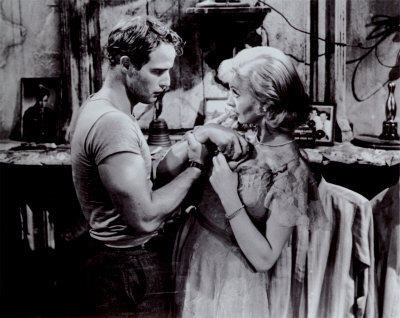
#6 DZP: A Streetcar Named Desire


Set in the French Quarter of New Orleans during the restless years following World War Two, A Streetcar Named Desire is the story of Blanche DuBois, a fragile and neurotic woman on a desperate prowl for someplace in the world to call her own. After being exiled from her hometown of Laurel, Mississippi, for seducing a seventeen-year-old boy at the school where she taught English, Blanche explains her unexpected appearance on Stanley and Stella's (Blanche's sister) doorstep as nervous exhaustion. This, she claims, is the result of a series of financial calamities which have recently claimed the family plantation, Belle Reve. Suspicious, Stanley points out that "under Louisiana's Napoleonic code what belongs to the wife belongs to the husband." Stanley, a sinewy and brutish man, is as territorial as a panther. He tells Blanche he doesn't like to be swindled and demands to see the bill of sale. This encounter defines Stanley and Blanche's relationship. They are opposing camps and Stella is caught in no-man's-land. But Stanley and Stella are deeply in love. Blanche's efforts to impose herself between them only enrages the animal inside Stanley. When Mitch -- a card-playing buddy of Stanley's -- arrives on the scene, Blanche begins to see a way out of her predicament. Mitch, himself alone in the world, reveres Blanche as a beautiful and refined woman. Yet, as rumors of Blanche's past in Auriol begin to catch up to her, her circumstances become unbearable. Thank you Mark Fleetwood

Now I only watched it for the Marlon Brando scream of "Sssttteeeeellllllaaaaaa!", and of course for the shirtless scene, but other than that, the movie couldn't really hold my attention. Blanche freaked me out, and I would never marry a man like Stanley. But tell me that sexy look doesn't make you blame Stella for jumping in bed with her Stanley in the first place...

Tuesday, June 22, 2010

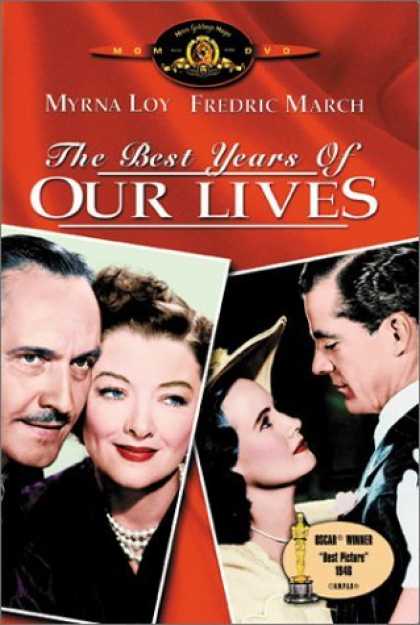
#6 DZP: The Best Years of Our Lives

I saw this movie in hopes that this classic will help me forget the pain of Mother Nature, and check me into happy-feelings.

At the end of World War II, a soldier, a sailor and an airman return to their home town of Boone City and must re-adjust to the society they had left several years before.

Al Stephenson was a banker before joining up. He is older than your average war veteran and gets home to find that his children have grown up and faces the difficult task of re-establishing an intimate relationship with his loving wife. At work, Al is promoted but now finds it difficult to be the hardhearted banker he seemingly once was.

Fred Derry was an Air Force Officer and Bombardier but realizes on his return that he has no marketable skills and finds himself in his old job at the pharmacy working as a soda jerk. He also finds that he had married in haste and that his wife, whom he'd only known for a few weeks when they married during his flight training, isn't quite as enamored with him now that he's out of uniform.

Lastly, there is Homer Parrish who lost both of his hands in a shipboard fire. He's become quite adept at using the prosthetics the Navy has provided him but resents the pity he sees in others eyes. He had hoped to marry his childhood sweetheart but is no longer sure he can burden her with his own physical limitations.

All three men become fast friends and with Fred Derry's marriage falling apart, he finds himself falling in love with Al's daughter, Peggy. In the end, all three finds ways to move forward with their lives.

Tuesday, June 8, 2010

DZP #6: My Plans

10 Classic Movies I Plan to See
And I’ve never seen any of them… sad but true…

•The Best Years of Our Lives, 1946
•A Streetcar Named Desire, 1951
•The Heiress, 1949
•Rebecca, 1940
•Lawrence of Arabia, 1962
•A Tale of Two Cities, 1935
•To Kill a Mockingbird, 1962
•Little Women, 1933
•The Birds, 1963
•Citizen Kane, 1941

Any thoughts...?